Wednesday, May 16, 2018

NZAIMs

NZAIMS  is an organisation that focuses specifically on learners in the Intermediate/Middle School years, and this event was an opportunity to explore issues and ideas relevant to our older learners. Two key presenters, Steve Francis and Alison Mooney,  facilitated the learning and discussion over the course of the day.

Adapt or Die:Thriving in Times of Change - Steve Francis
Steve suggested that we are reaching a tipping point in education, where change of some time is almost inevitable. With this in mind, we need to consider the implications for both our school staff and our parent community, as school is different from what they have previously experienced.

He talked about there being predictable stages of concern when people are faced with change (Ken Blanchard). These are:

  • Give me all the information
  • What does this mean for me?
  • How will we start implementing?
  • Impact (when you start doing)
  • Collaboration (best done with someone experiencing the change alongside you, or a little way ahead)
  • Refinement
It is important to keep in mind that you need to take time to address the first two points, before you can successfully address the others. Steve noted that there are two factors to successful change; your attitude and your ability to learn. Keep in mind that things tend to get worse before they get better.

When it comes to implementing change initiatives, you should only focus on 3 big areas per year (Steve referred to these as the 'big rocks'). It is important to communicate these clearly and consistently and monitor progress towards your goals. As a leader, you need to be clear about what it will be like after the change, paint a picture so that you have a clear and compelling vision. A suggestion was to priority plan and break the year into 5 week chunks, and to display this in the staff room so that everyone can see where they are heading and the progress made to date.

Motivation is the key to successful change and there are three key drivers for motivation:
  • Purpose - people like to be purposeful
  • Mastery - people like to be seen as good at what they do
  • Autonomy - people like to have the power to make some choices
However, it is also important to be clear with everyone about the flip side of each of these:
  • Responsibility - because we change lives
  • Change - be willing to tweak and refine
  • Accountability - yes you have choices, but if these are not leading to outcomes for our learners then this is a problem
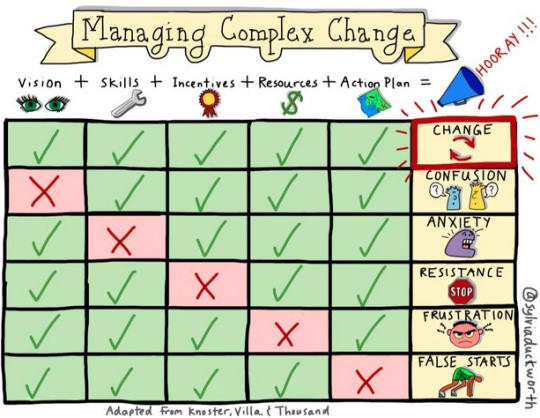
In order to achieve desired change, you need to have a compelling vision or you will get confusion. Change needs to be planned and staged or people will feel that the pathway is unclear. Training needs to be provided, if required, or people will feel anxious. You need to ensure the necessary resourcing is in place or people will feel frustrated. Finally, momentum needs to be established or people will get 'change fatigue'.

Four Things Great Leaders Do and Three They Don't - Steve Francis

Leaders need to make sure all of their 'moments of truth' are sending the messages that they want to be sending. This includes when meeting with members of the school community, online interactions and all of the usual home/school communication. 

Great leaders focus on their teachers; they ensure they are doing everything they can to make them feel supported and valued, while also ensuring they are on the same page with the school's vision and beliefs, and that they are accountable for themselves and their learners.

There are four key criteria for identifying a great leader:
  • They expertly manage staff, students and parents, keeping in mind that all 3 groups are interrelated and connected
  • They make decisions based on what their 'best people' will think
  • They focus on people, not programmes
  • They ruthlessly invest their time and do what only they can do, delegating other tasks as appropriate
Fostering Intelligent Relationships - Alison Mooney

This was an exploration of 4 key personality types: Playful, Powerful, Peaceful and Precise. Being aware of an individual's personality can help with responding and interacting with others in a purposeful and productive way. 

Alison identified a key word for each personality type:
  • Playful - People
  • Peaceful - Steady
  • Precise - Thorough
  • Powerful - Action
Each personality type has a specific leadership style:

  • Playful - Inspirational leader. Loves to encourage
  • Peaceful - Diplomatic. Cares about people
  • Precise - Strategic. Sets goals and works backwards from them in order to work out steps
  • Powerful - Visionary. Loves achieving things
Finally, each personality type has a different set of needs:
  • Playful - attention, affection and approval
  • Peaceful - respect, value and harmony
  • Precise - space, quiet and sensitivity
  • Powerful - credit, loyalty and appreciation

To explore the four personality types further, read Alison's book "Pressing the Right Buttons"


Friday, May 11, 2018

Making Connections with our iwi and HPPS

Lots to highlight in this post:

Iwi Consultation:
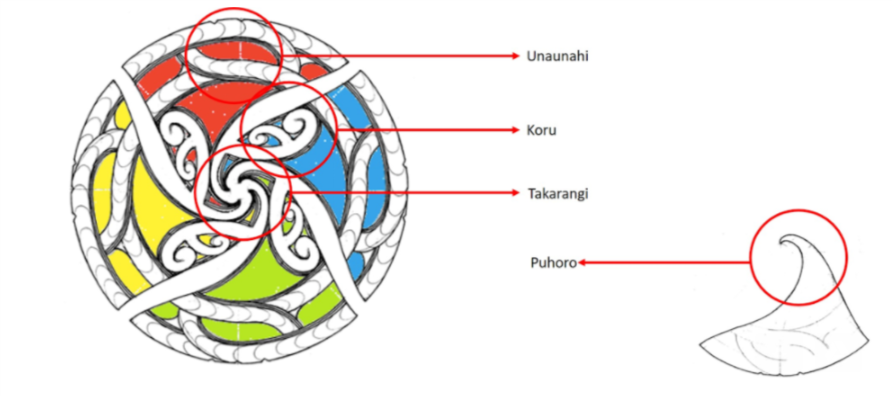
We have been so fortunate to have such high quality support and engagement from the local iwi Ngati Whatua O Kaipara.  It began with the gifting of our school name, alignment with our school vision and continues with support in aligning the cultural narrative to our school approach including our logo, branding and learning hub names.  Tracy Davis and Te Rongopai Morehu have been hugely instrumental and generous with their time and knowledge.  Tracy also connected us with Graeme Tipene who is a talented designer who worked with us to develop our logo, which will also begcome the framework for our learning model.  Te Rongopai and her colleague Dawn Piper have also gifted us PL time this term working with our SLT to ensure we are honouring the history of the local area, including appropriate tikanga in our process development and in selecting our whakatauki for our kainga (learning hubs).  They have also gifted us the names and stories of four animal with significance to the iwi to use symbolically for our kainga.  We'd also like to thank both Dawn and Te Rongopai for translating our mihi and planning ahead with us for Term 4 PL (we have applied for MOE PLD Funding to heighten our Te Reo and Tikanga knowledge- fingers crossed).

See all of our work in our Cultural Narrative document.

Growing our Team
I have been working with Alan Curtis to develop our process for recruiting our Office Administrator who will start in Term 3.  We have had a lot of interest and applications and interview our shorlist of candidates on Friday.

First Time Principal Support

My FTP support continues as well with meeting with Brian Gower who has provided me with essential advice and support with connecting at the MOE level.  Highlights from our March Hui included Appraisal with Dr Wendy Moore, Julien Le Sueur- Getting to Know Your Ministry, Carmel Riordon- Financial Mgmt and Patrick Ikiua from the NZSTA on Governance tips.

Here are my notes from the useful FTP Huis as well.


Immersion in our Current Context
Opportunities abound here at HPPS to learn from and with the team.  Kirstin and I joined in on a TOD session led by Daniel and Lisa that both inducted, grounded and guided their team into their approach to conceptual curriculum design.  So much goodness to borrow from their approach.  We also had an in depth tour of HPPS with Lisa who provided highlights of their leadership and learning journey as they have grown from 50 to 500 since opening.  She talked about how they are working to infuse more play based learning approaches to enhance their learner centred, dispositional approach to T&L.  There was also talk aout how they are focusing on HOW devices are being used in the school to maximise the impact of device use, while increasing exposure to and use of other media for learning.  We were also gifted some time with Kristyn, one of the DPS, who delved deeply with us into their coaching approach- including some very useful advice and some questions we can use to frame our MATEs (Mutually Agreed Team Expectations) which we will develop for the SLT in Term 2.  Kristyn is an absolute think tank and we will be hounding her for more insights along the way!

Friday, May 4, 2018

And then there were 2 (+ 3 for a day)

Term 2 is upon us already and this week I was so excited to welcome Kirstin Anderson McGhie to the team.  We had a wonderful first day where I was able to share with Kirstin our progress to date and review the Launchpad (our action plan and initial induction space).  We spent the last of the day colouring in the marine animals that Graeme Tipane has designed for us for the external signage which will frame the learning spaces, to be called kainga.  On Friday, Wendy joined us for our first road trip for our Leadership PLG with Te Uho O Te Nikau, Taumata and Te Ao Marama at Rototuna Campus outside Hamilton.  This was the first time we all met together with our DPs.  It was a highly engaging day of sharing and learning nad involved:

  • Sharing our story to date highlighting our vision, branding, developing themes and emerging curriculum ideas
  • Time with Natasha Hemara who is the Foundation Principal of Rototuna Senior High (sharing her establishment and foundation journey along with advice and Q&A)
  • Time with Fraser Hill and his lead team, Foundation Principal of Rototuna Junior High School
  • A tour of the wonderful Rototuna Junior High School (the team shared a candid recount of their establishment journey and foundation year where they had 600+ learners on Day 1 and growing fast!)
  • Time for Q&A and genral discussion around staffing, recruitment, PL, budgets, IT procurement and community consultation along with a discussion of 'ILE in the News' which we tabled as important given the amount and type of media coverage ILEs get and spent time ideating how we could collate the research, articles and general responses
See our shared presentation below (I gave Canva a go!).  Looking forward to our leadership retreat in July in Mt Manganui where we meet again and join forces with Mr Twinkly, Mark Osbourne:)


Te Kura Tuatahi o Matua Ngaru by Diana Wilkes

Friday, April 27, 2018

The Learning Brain with Nathan Wallis and Andrew Fuller

On April 26, Wendy, Kirstin and I attended "the Learning Brain" Conference at Waipuna hosted by the Learning Network. The two keynotes, both well known experts, certainly compelled our brains to learn!

Nathan Wallis began the day enlightening us with how much we have learned about cognition, or the Learning Brain, or Tikaka o Ka Roro, since the 1980s due to advances in technology, namely scanning.  Before this, all we knew about brains was learned from researching dead brains.  He provoked us by sharing the fact that genius has very little to do with our genetics and that there are no genes that pre-determine your intelligence (did you know we have 3000 less genes than a fruit fly?!).  The biggest developmental impact on our brains comes from how many spoken words a baby hears in their first 1000 days which is known as the diad or one on one relationship.  Those who have a poor diad have a greater risk of brain development but these can be counter-balanced or 'absorbed' by resiliency factors which include:  birth order, gender, parent home for first year, learn to play an instrument, speak multiple languages, educated parents, close relationships with extended families.  Those the risks continue with alcohol-drug abuse, physical abuse, transient, not spoken to in native language etc.  


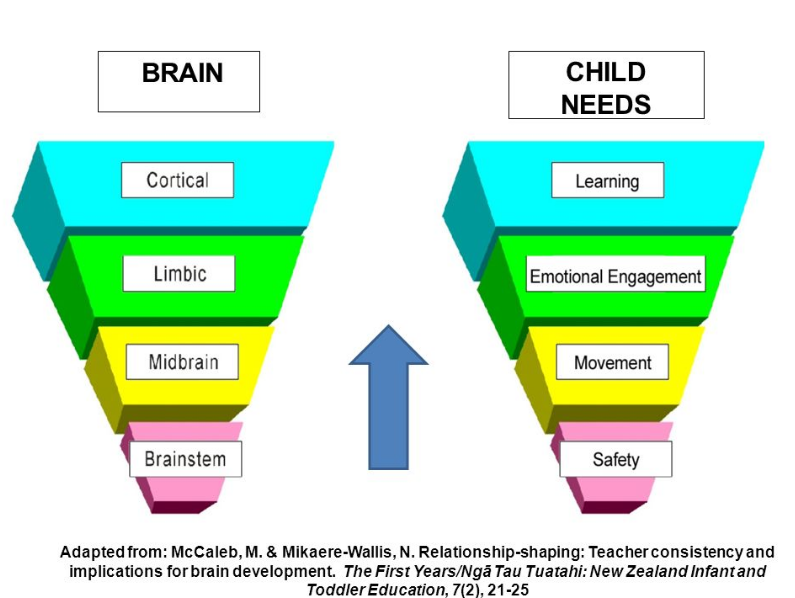
He then continued to re-educate us on the neuro-sequential brain, and this is where the penny drops.  Brains 1,2 and 3 are compulsory- all info comes in through these brains (think of a four story house) and we need these to live

1-Survival: brain stem (Heart rate: fight, flight, freeze)
2-Movement: Movement brain (reptilian brain- coordination)
3-Limbic system: Emotional brain (responses)
But, Brain 4 is our emotional brain- where we experience empathy and higher intelligence:
4-Cortical- Learning brain (empathy, controlling self, literacy)

Something else we need to bare in mind is that our brain is not completely developed until we are in our twenties and females usually faster than males (and first born is usually faster too).  He also stated that a teenagers learning brain shuts off for a few years, so they are more like a 3 year old than a 16 year old.  

Provocation: prisons are full of males that are not first born, many in their twenties, what do we do with this information?!  

Andrew Fuller followed with information about how to rewire our brain, bombarding us with facts about the science of our brains and that 'goals are good but systems are better'.  Meaning that we need to develop systems that enable the full potential of our brain power, namely eating well and sleeping well.  He shared information about the neurochemicals in our brain and how they influence our actions and how our systems can enhance and amplify desired effects. For instance, to increase dopamine, which motivates, gives pleasure and increases attention we should engage in problem solving and sports and avoid computer games and we should eat fish, oats, peanuts, seeds and tofu.  

After a quick break we were back to Nathan Wallis who talked to us about X Factor Education.  Our brain is a biological relationship machine which is based on the neuron, or brain cell.  There are different types of neurons but at the center of each is an electrical charge and when neurons connect it is this charge that connects to form neural pathways and this is where the information is stored (connectivisim theory).  The brain has a system for keeping or rejecting the synaptic connections iand this is where myolin comes in.  Myolin (white matter- fat based- insulator over the pathways) is laid down when we practice a skill- each time adds another layer and it needs to be done 90ish times to become truly 'learned'. So our prior knowledge is a network of synaptic connections (consider how fast we learn fractions as an isolated lesson versus learning fractions as we learn to bake).

Nathan says that the love of learning comes in brain 3 and we must be careful to not kill this brain, and the hippocampus can be thought of as the 'google' of our brain, not the library. Our happy hormone, endorphins, enable myolin to be laid down more quickly and thus make learning faster. So how do we increase endorphins? Sex is the biggest rush of endorphins! So since this can't be addressed in a school context we need to develop situations and learning experiences to heighten:

1.Laughing -laughter yoga,  
2.Movement is intricately related to learning- fidgeting is good!
3.Our Major Pedagogy- should be singing!  #1 way to release endorphins.  If we are singing we are not in SURVIVAL mode.
To decrease these we encourage the release of cortisol. When cortisol is released is removes the latest learning (the last synaptic connection) and he suggests even using the words 'no' or 'don't' versus could you.... can release cortisol. So as educators we can think of the brain as a garden where endorphins fertilize learning and cortisol is pesticide that kills the newest learning.
  • Myolin is the ashpalt of our brain - making our synaptic connections permanent knowledge/skills.
  • Poutama- MOE- symbolic of learning brain
  • Endorphins speed up learning.
  • Countries with compulsory music programmes produce best mathematicians eg. Hungary, Japan, Netherlands…
  • Autistic children- have higher levels of cortisol
  • Brain’s job is to VISUALISE oral language- 25% of the brain pictures what you say whether it is do or don’t so if we don’t want them to do something don’t use those words- say the opposite.
Takeaways:
Then we were back to Andrew who brought use back to discussing the brain and food relationship in more detail.  Some highlights:
Make data visual- animate it? https://www.youtube.com/watch?v=jbkSRLYSojo
  • Teach the concept before you ask questions about the concept. Brainstorming is a waste of time?!
  • If we are going to label anything, label strengths.
  • Power of feedback.
  • Exploit the memory and oralfactory connection- make our school smell good
  • Be visual
  • GET IT Model: Getting Ready to learn, Experiencing difference, Trying it out, Information Processing and Transfer.  
  • Be diagnostic BEFORE you 'treat or intervene' Learning Strengths inventory.  http://andrewfuller.com.au/free-resources/
  • How do we diagnose the ‘ blockages’? In the different areas?
    Language and Words, Spatial Reasoning, Thinking and Logic, Perceptual & Motor Coordination, Planning & Sequencing, Numbers, People Skills, Concentration & Memory,
  • The Power of Feedback- especially important to help boys make progress. https://www.youtube.com/watch?v=Cbk980jV7Ao
  • Increase visuals. Get kids to point to stuff. Provide repetition. Note taking- break page into 3 parts with a venn diagram at bottom (see pic).  Give your memory a hand. Silence. Similarities and differences. Relationships - how do we collectively own the kids to create a powerful sense of belonging
  • Need our kids to know to ask for help. Help our kids know what they are good at.
  • Anxious and avoidant times (survival type responses)- use the growth mindset to manage the challenges.
    My brain is a binary system.
  • Decision Making→ PICCA: problem then 5 whys I wants, Choices, Comparisons and Action.
  • Shark thoughts (i should be able to …) and Dolphin thoughts (helpful ideas!).  
  • Teach kids to concentrate! Concentration→
    Happy Wanderers- Frequent Flyers- Spies (know more about the school than anyone else, love challenges)- Amplifiers (make everything louder and more intense)- Fidgeters (tend to collect things)- Star Trekkers (give them a chance to get things wrong- make them take risks).  Do not feed the fears
  • How can ‘ David’s beat Goliath’s’ 
  • How smart are we? (self, people, music, picture, logic, word, number, body…) → analyse our strengths (MI quiz)
  • Optical illusions… where’s wally? What do you see?  
  • Prioritisation.  Learn to prioritise.  What do you need to do NEXT?  KIS = success. Be the boss?  
  • Glass half empty?  Focus on what IS there not what is not. The magic happens when we are well beyond our comfort zone.  
  • It takes 6 weeks to form a habit (to cover the synaptic connection with enough myolin)
Wow.  Overloaded learning brain!  Need to learn to morph our sharks into dolphins, not care what others think and turn our opponents into our allies.  If we fall down 7 times, we get up 8!


Monday, April 23, 2018

3 Brains Overflowing - NZEALs Conference with Mel and Bev


On April 18th to 20th I was fortunate to attend the New Zealand Educational Administration Leadership Society conference at the Pullman Hotel in Auckland. This organization supports leadership and innovation in education sectors in New Zealand. They have strong networks across primary, secondary and tertiary education institutions and are known for sharing research as well as quality practice while supporting aspiring and existing leaders.

I attended the conference with the lovely and lively Mel Bland and Bev Aerenga from Te Uho O Te Nikau. We thought that the conference was well organized with a range of inspirational think leaders as presenters providing us with a smorgasbord of learning around reconceptualusing leadership in Aotearoa. It was clear to us that a lot of thought had been put into the design of the three-day conference as each day had a different Focus.  For example Wednesday was about leadership for cultural inclusivity Thursday focused on leadership for collaboration and Friday was all about leadership for sustainability. 

My thinking was challenged around how we engage Maori and Pacifika communities within our New Zealand education sector. We were provoked as educational leaders to consider how we could should and need to enact change in our schools to ensure equity while remembering that the context of each individual school and surrounding community is central to how we do this. Organizational change requires leadership, relationships and project management skills and in order to enact this change we need to be transformative servant leaders. 
See all of my notes here and my Synopsis below. 


Kicking things off we were immersed in the aspirations of Chris Hipkins, Minister of Education who reminded us that educational leadership, not governance, will make the biggest difference for our learners and that we have the responsibility to empower the teaching profession by unleashing the potential of the NZC without the constraints of National Standards. And closing the conference was Professor Martin Thrupp from U of W emphasising the importance of policy and being brave leaders through our individual and collective leadership voice.

Tahu Kukutai (UoW) challenged us to consider if we are working towards diversity or divergence and proclaims that Maori have been removed from the conversation at the policy level for too long.  The professor asks how are we addressing racism and colonialism in our education system when more than 10% of people identify with multiple ethnicities and more than half of Maori identify with another ethnicity? If Te Tirit o Waitangi is essentially our first immigration policy, how are we honouring this? Do we as a nation view Maori as a problem to solve and migrants as a resource?  What is our vision for national belonging and how can we embrace an indigenous disposition? A lot of questions with little time for discussion on possible solutions. Fortunately, Professor Melinda Webber (UoA) reminded us of the aspirations within Ka Hikatea and the 8 characteristics (Ka Awatea) for realising Maori potential.

Local leaders Deidre Alderson, Laurie Thew and Di Cavallo share how their schools embrace and respond to cultural diversity highlighting the need for cultivating a sense of belonging through visible values, strong educator-learner relationships, effective transitions to school and how doing what we do when we don’t know what to do (as leaders) sets the tone for our school community.  Additionally, Sue Dockett, ECE expert from University of Australia suggested that effective school transitions are seamless, invisible, peaceful and to achieve these we must examine the: opportunities, aspirations, expectations and entitlements of those involved.  How do we develop social respect, personal regard, competence and perceived integrity as we induct whanau into our schools?

Damon Salesa charismatically provoked us with the fact that future Pasifka leaders are here in NZ, and we have segregated ourselves socioeconomically and ethnically, so how are we growing this leadership resource?  If we know disruptive innovation occurs in areas of disadvantage and every single Decile 10 ten school outperformed every single Decile 1 school what does the future hold?

Noelen Wright shared her research on how educators and learners make sense of an ILE (Rotouna), the nature of collaboration and involving community in learning authentically, calling for leaders to think and act differently.  Her learning identified the difficulties and struggles of leading in ILEs which aligned with the message from Rachael McNae (UoW) who highlights the importance of relational leadership- why is change so unnatural in human organisations?

Ross Notman, University of Otago, outlined his research on what effective principals do→  1.Leading T&L, Support for staff PL 3.Care for our OWN personal and PL 4. Collaborative Leadership Strategies  5. Intrapersonal leadership. Dr Bruce Barnett, University of Texas shares explores the differences between mentoring (expertise, longer)  coaching (skills based) and counseling (emotional) and how these feature in our development and induction of emerging leaders.

Dr Howard Youngs proclaimed we are human beings not human doings and asks “what’s damaging the conditions of learning, teaching and research in your organisation?”  While Murray Fletcher reminded us that the hardest thing to shift is a person's beliefs. What do I/we stand for? How can we go about connecting head, heart and hand because modern leadership needs integrative thinkers and thinking!  What are the cognitive, psychological and social aspects of effective leadership?

Saturday, April 21, 2018

Googlicious learning at the Google Summit with the #DreamTeam

On April 16-17 Kirstin, Wendy, Michael, Heike and I had our brains reinvigorated with a plethora of learning experiences shared by educators from across NZ and the world.  Where were we?  At the Google Summit at Aorere College.

As a Google Innovator (#GTASYD14) I was excited at the prospect of attending a summit and not presenting.  Michael, on the otherhand, was busy all day on the first day with back to back sessions including some of the wonderful @OrmPS learners to help him facilitate.

It was wonderful to spend these two days with the team and other wonderful, enthusiastic, future focused educators.  We used a shared google presentation to capture notes so we could all share the note taking on the day and the learning ubiquitously forevermore!

Please feel free to peruse of ponderings....

Friday, April 13, 2018

Term 1- it's all Over Grover!

What's the haps highlights:
Spotless and I have made huge progress with our FF&E.  The furniture types and quantities have been decided and James and I had a colour meeting with Spotless and ACG Architects to decide on the colour schemes for our learning zones as well.

Learning highlights:
It was wonderful to visit Riverhead, Huapai District School, Taupaki and Waimauku schools.  These schools all share a 'school zone' border with Matua Ngaru and it is important for me to begin forging a relationship of collabroation with each.  Kris, John, Pete and Gary were very welcoming and open in our discussions and I am confident we have begun with a positive connection.  In addition to meeting with the local school principals and touring their kura, I also had the opportunity to visit two Microsoft schools to see how they use the MS365 apps.  Hill Park is in the beginning stages of their use and Opaheke is a Microsoft Model School, well entrenched in their use of the platform.  I can see a lot of potential for us to use these in our multi-platform school, particularly with the older learners and our staff and the absolute potential for Minecraft EDU is powerful.  I can't wait to learn more and design ways for integration into our curriculum design and systems set up.

I also spent some time with James, principal at Arohanui Special School and an EBoT trustee, discussing how he envisions a learning support model could operate out of the Arohanui Hub on our shared campus.  His plans are exciting as they would enable staff to support more learners with high learning needs more effectively but the model is awaiting approval.  His work with Tracy Martin has been very fruitful and we will wait with anticipation to see if we can enact it at Matua Ngaru.

I can't believe that the term is coming to an end!  I look back and see how much I have learned, and yet I look forward to see how much more there is to do.  While overwhelmed at times I remain absolutely committed to and excited about setting up Matua Ngaru for our wonderful tamariki.

What's next?

  • Google Summit (our whole team to attend in the break #DreamTeam!) 
  • NZEALs (in the break with Mel and Bev) 
  • NZAI PL (Kirstin to attend in my stead) 
  • Kirstin starts in week 1 
  • Wendy Starts in Week 3 
  • Auckland School Visit Extravaganza with Te Uho O Te Nikau in Week 7 & 8
  • Rototuna Principal PLG 
  • WAPA Reflective Practice PL
  • The Learning Brain PL
  • Next Practice PL (@OJC)
  • IT procurement
  • ERO visit #3
  • and so much more ....

Sunday, March 25, 2018

100 Languages of Children PL

On March 24 Mel and I particpated in a wonderful day of learning about Reggio Emilia approaches at the Pakuranga Baptist Kindy.  Please see my notes below to capture the essence of their wondrous ways that found us so incredibly inspired!

Saturday, March 17, 2018

From our values and beliefs to our principles and practices...early work with the SLT


#Dreamteam

Our team has been spending a great deal of time (their own time I might add) enthusiastically contributing to our curriculum development.   Kirstin, Wendy, Heike, Michael, Megan (EBoT) and I worked together on two Fridays after school in Term 1 to begin this very important work.  I am very pleased that I was able to appoint all four of these amazing educators last year so that they could contribute to this pivotal and foundational work before they are employed.

This of course begins with a firm grounding and shared understanding of our vision, uncovering our beliefs about learning to form our learning values and this will then lead to the construction of our curriculum framework which will underpin our approach to teaching, learning and assessment.  We used the following slides to guide our process.

Tuesday, March 6, 2018

Sharing our journey -ERO Visit #2 March 12

We hosted the team from ERO- Deb Jolly, Cynthia Manion and Graham Tregaweth on March 12 at Hobsonville Primary School.  We had lots of news to share with them since Alan and I met with them in November of last year.  The Board and I spent a number of hours with them sharing our progress to date using 12 criteria that they had suggested last year.  You can see these slides below.  We are confident that we assured them that we are very much on track to a successful opening.  Thank you to Alan, Megan, Dianne, Te Rongopai and James who supported me while we shared our progress report.

Monday, March 5, 2018

Powerful Connections and Purposeful Learning - New School Principals PLG @HPPS


A different kind of CoL!
Our new school principal PLG began in 2017 with the purpose of sharing and collaborating as we all move towards developing and opening our new schools.  Tony Grey- Te Ao Marama School in Hamilton, Gen Fuller- Taumata School in Tauranga, Mel Bland- Te Uho O Te Nikau and myself decided to join forces and share insights, resources and challenges along the way.


Image result for endeavour primary school hamilton nzIn Term 4 of 2017 we had our first face to face meeting which Tony coordinated for us at Endeavour School with principal Marcus Freke.  Endeavour opened the same year that Ormiston Primary (my previous school) did and he shared with us the journey that he, his leadership team, his teachers and his learners have been on to date.  Focusing of course on issues pertinent with opening a new school, emphasising the establishment phase, staffing and lessons learned. We also toured his school, Stage 1 (2015) and Stage 2 (2016-2017). As Marcus guided us on the tour he discussed the furniture choices, how the spaces are used and the rationale behind the changes made between the two stages.

In Term 1 of this year, on March 5th, I hosted our PLG at Hobsonville Point Primary School.  Tony and Mel stayed at Chateau Wilkes the night before and we enjoyed getting to know each other a little better before the 'mega learning' ensued.Image result for hobsonville point primary school logoDaniel Birch, principal shared his highlights of opening a new school and provided sound advice on what to focus on and why.  He suggested that we make sure that we take time for ourselves to do some learning- we won't this this time again, but not to re-invent the wheel.  Focus on the two questions: what is powerful learning and what is powerful to learn with our foundation teams and gain clarity around what this means for us.  He also shared their collaborative recruitment process, use of the Hermann's Brain model to develop an understanding of each other and the importance of what the vision is, means and ensure all own it!  He also suggested some key thought leaders: Julia Atkin, Guy Claxton, Mere Berryman, Hattie etc. we could engage with and some stand out professional readings: enGauge 21st Century Skills, Literacy in the Digital Age https://pict.sdsu.edu/engauge21st.pdf . Lastly, he shared with us how his staff uses coaching. Ultimately, his big piece of advice is to be responsive to what's in front of us and get other principals (be careful of your advice Dan!) to come and speak to our teams.
We then took a tour of the school (it amazes me how much 'new stuff' I notice about their approach each time I walk around) to showcase their lovely school and the diverse, yet cohesive, approaches they use to deliver their conceptual, learning values and dispositions based curriculum while discussing how they have evolved since they opened 6 years ago.Image result for rototuna junior high schoolWe spent the rest of the day discussing matters such as our school names, visions, logos, cultural narratives, property matters, staffing issues & future PL opportunities. We're looking forward to our next PLG - likely to be at Rototuna where Tony is currently based.